Article
Rice, Rules, and Rural Roads: Evolutionary Dynamics of China’s Milled Rice Industry
Changjun He 1 , Rajah Rasiah 2,* and Chng Saun Fong 1
1 Institute for Advanced Studies, University of Malaya, Kuala Lumpur 50603, Malaysia; 23103872@siswa.um.edu.my (C.H.); fongcs92@um.edu.my (C.S.F.)
2 Asia Europe Institute, University of Malaya, Kuala Lumpur 50603, Malaysia
* Correspondence: rajah@um.edu.my
|
Citation: He, C., Rasiah, R., & Fong, C. S. (2025). Rice, Rules, and Rural Roads: Evolutionary Dynamics of China’s Milled Rice Industry. Agricultural & Rural Studies, 3(4), 22. https://doi.org/10.59978/ar03040019 Received: 25 July 2025 Revised: 15 August 2025 Accepted: 21 August 2025 Published: 20 November 2025
Copyright: © 2025 by the authors. Licensee SCC Press, Kowloon, Hong Kong S.A.R., China. This article is an open access article distributed under the terms and conditions of the Creative Commons Attribution (CC BY) license (https://creativecommons.org/licenses/by/4.0/). |


Abstract:
China’s milled rice imports present both opportunities and challenges for the transformation of its rural agricultural supply chain. However, the mechanisms through which international rice trade co-evolves with domestic supply chain upgrading remain underexplored. By isolating trade volumes, price effects, or food security concerns, previous approaches risk oversimplifying policy design, as they fail to account for how shifts in government incentives, market procurement preferences, and smallholder upgrading decisions dynamically reinforce or undermine one another over time. This study addresses that gap by integrating SWOT analysis into a tripartite evolutionary system to model the strategic co-adaptation of the stakeholder groups. Simulation results demonstrate that aligning incentives across the three stakeholder groups leads to stable and mutually beneficial equilibria, which the SOAR framework reframes as dynamic levers in a complex adaptive system. By revealing how positive feedback loops are generated, the results offer actionable guidance for improving market inclusivity, enhancing rural incomes, and ensuring long-term food system stability in the face of global trade pressures. In conclusion, this study provides a strategic framework for fostering a cooperative, resilient, and high-performing rice supply chain through the coordinated evolution of government, market enterprises, and smallholder strategies. The insights can inform targeted interventions that simultaneously advance rural prosperity. Future research could enrich the model by incorporating climate risks, international market shocks, and digital supply chain innovations to capture emerging challenges and opportunities in the global agri-food landscape.Keywords:
food security; rural economy; supply chain upgrading1. Introduction
Rice holds a central place in China’s food security strategy and rural economy. Beyond its role as a staple food, rice cultivation in China generates a variety of valuable by-products that underscore its broader economic and ecological importance. Rice husks, bran, and straw, though often seen as agricultural residues, are increasingly utilized in bioenergy production, organic fertilizers, construction materials, and even animal feed, contributing to circular agricultural practices and rural industrial diversification. For instance, rice husks can be converted into biomass energy, supporting low-carbon transitions in rural areas, while rice straw is being repurposed into biodegradable packaging and soil enhancers. Building on recent advancements in green remediation, the study (Irshad et al., 2022) offers exemplary and valuable insights for sustainable rice cultivation in contaminated regions. In the context of rice biomass utilization, Sriariyanun et al. (2022) showcase a promising one-pot approach using IL-tolerant cellulases for efficient lignocellulose breakdown, offering novel opportunities to valorize rice straw and by-products in biorefinery applications. These outputs not only reduce waste but also enhance the value chain of the milled rice industry, reinforcing rice as a strategic crop that drives innovation, environmental sustainability, and rural resilience in China’s agricultural landscape.
As a country with vast consumption demand and complex regional production patterns, China has traditionally depended on domestic rice cultivation to stabilize supply. However, over recent years, increasing openness to international grain markets and supply chain modernization have transformed China’s rice landscape. Particularly, the milled rice import has grown as a complementary supply channel, meeting diversified consumer demands and supporting price stability amidst periodic fluctuations in domestic production, which present both opportunities and challenges for the transformation of its rural agricultural supply chain. While international rice trade can stimulate rural economic upgrading, the underlying mechanisms through which trade interacts with domestic supply chain evolution remain underexplored. Existing research often isolates variables such as trade volume, price effects, or food security concerns, resulting in fragmented insights that oversimplify policy design. This reductionist approach neglects the dynamic interplay between government incentives, market procurement strategies, and smallholder upgrading behaviours. These interactions can either reinforce or undermine long-term supply chain resilience. Between 2020 and 2022, China’s milled rice imports remained relatively stable and regionally concentrated, sourced predominantly from ASEAN countries and South Asian exporters such as India and Pakistan. Since 2023, a noticeable shift has emerged that imports from traditional suppliers have declined, while India has significantly expanded its presence in the Chinese market. In contrast, non-Asian exporters have seen their share shrink, reflecting a broader trend toward regionalization and a preference for cost-efficient, high-quality supply channels. In examining China’s imports, the USD/RMB exchange rate is often used as a proxy for external price sensitivity and import purchasing power, while the CSI Agricultural Theme Index reflects broader trends in agricultural sector performance and market sentiment. These indicators are commonly employed to interpret fluctuations in trade volumes through financial and macroeconomic lenses. Figure 1 presents the milled rice import structure from 2020 to May 2025, with the data obtained from Customs Statistics, General Administration of Customs of the People’s Republic of China (http://stats.customs.gov.cn/). However, as illustrated in Figure 2, the expected directional correspondence between these variables and China’s milled rice import trends does not prominently emerge.
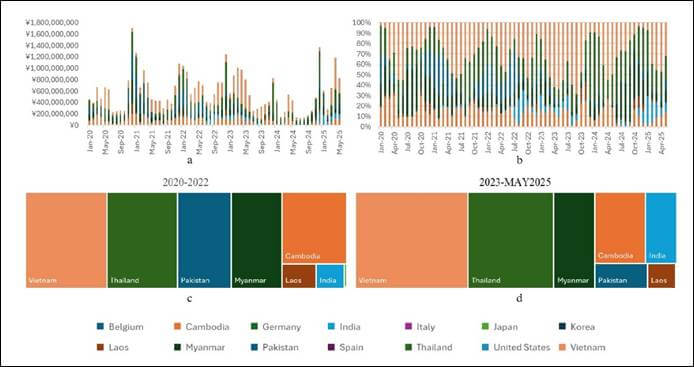
Figure 1. China’s Milled Rice Import Structure from 2020 to May 2025: (a) Monthly Import Value (RMB); (b) Country-wise Monthly Percentage Share; (c) Country-wise Proportion (2020–2022); (d) Country-wise Proportion (2023-May 2025); Data Source: China Customs.
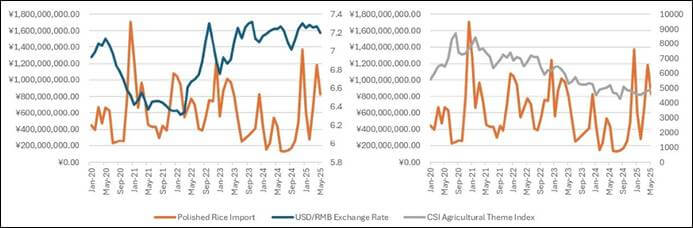
Figure 2. Comparison of China’s Milled Rice Import Value and Financial Index from 2020 to May 2025.
Figure 1 and Figure 2 are pivotal to
the manuscript because they provide empirical grounding for the argument that
China’s milled rice import patterns are undergoing a structural transformation
that cannot be fully explained by conventional macroeconomic or financial
indicators alone. Figure 1 is included to visualize the evolving structure and source composition of China’s milled
rice imports from 2020 to May 2025. By depicting both the monthly import values
and country-wise proportions, the figure highlights two key trends. Trend 1 is
the regional concentration and relative stability of imports prior to 2023. Trend
2 is the subsequent rise in India’s market share and a decline in non-Asian
exporters post-2023. This supports the paper’s thesis that China’s rice import
dynamics are increasingly shaped by structural, regional, and demand-side
forces, rather than purely by trade liberalization or short-term price signals.
Figure 2,
in contrast, serves to challenge a common assumption in trade analysis that
variables like the USD/RMB exchange rate or the agricultural sector index (as
represented by the CSI) are reliable predictors of import behavior. By showing
the lack of strong correlation between these indicators and milled rice import
volumes, Figure 2 justifies the study’s shift in focus toward institutional, supply
chain, and consumption-driven explanations. It reinforces the idea of a
structural decoupling between financial signals and trade behavior in this
sector. Together, both figures establish the empirical necessity for an
evolutionary game-theoretic approach that captures the strategic interactions
among government regulators ( ), milled rice enterprises (
 ), and domestic smallholder producers (
 ), which is a framework that traditional linear or econometric
models may fail to capture. Thus, the inclusion of these figures is not merely
descriptive, but integral to motivating and legitimizing the model-based
analysis that follows. Given
this absence of strong alignment, the present study focuses instead on more
direct structural and demand-side factors driving import behavior. Similarly,
the underutilization of domestic rice futures markets reflects a broader
structural dynamic. While japonica and indica rice contracts are listed on the
Dalian Commodity Exchange (DCE) and Zhengzhou Commodity Exchange (ZCE), their
relatively stable pricing shows limited responsiveness to changes in milled
rice import volumes. This decoupling is perhaps unsurprising, given China’s
position as a major rice-producing nation with a high degree of
self-sufficiency. Consequently, external price cues appear to play a more muted
role in shaping import behavior. Instead, fluctuations in milled rice imports
seem to stem primarily from evolving domestic consumption patterns, such as
rising quality expectations in urban areas, regional taste variations, and
broader nutritional transitions. Within this context, imports function less as
price-responsive substitutes and more as targeted supplements to meet
differentiated domestic demand, reinforcing the structural, demand-led nature
of China’s milled rice trade. Chinese
importers still tend to rely on market signals rather than domestic futures for
decision-making. This structural decoupling becomes even more significant in
light of a striking new trend: from January to May 2025, the value of imported
milled rice rose sharply compared to the same period in 2024, with year-on-year
increases of 37.50%, 87.80%, 179.10%, 120.80%, and 88.97%, respectively. These
unprecedented surges point to a growing preference for international sources at
a time when China is also prioritizing rural revitalization, food security, and
supply chain upgrading. This study focuses exclusively on the market-oriented
operations of China’s milled
rice industry and does not address policy-based procurement mechanisms. The
combination of regionalized sourcing, weak futures market integration, and
accelerating import dependence underscores the urgency of re-evaluating how
policy, market strategies, and supply chain structures evolve together.
Although milled rice imports have become an increasingly important complement
to China’s grain supply, the mechanisms by which international trade co-evolves
with domestic agricultural upgrading remain poorly understood. Much of the
existing literature addresses trade volumes, price fluctuations, or food
security outcomes in isolation, often overlooking the dynamic interactions
among government policy incentives, market procurement strategies, and the
upgrading behaviors of smallholder producers. Since 2023, a notable shift has
emerged in China’s rice import
pattern, characterized by regional consolidation of sourcing and a significant
rise in import value, particularly between January and May 2025. These
developments point to a strategic realignment among the key stakeholders in
China’s rice economy, yet this transformation has not been systematically
analyzed using an integrated, evolutionary framework.
), which is a framework that traditional linear or econometric
models may fail to capture. Thus, the inclusion of these figures is not merely
descriptive, but integral to motivating and legitimizing the model-based
analysis that follows. Given
this absence of strong alignment, the present study focuses instead on more
direct structural and demand-side factors driving import behavior. Similarly,
the underutilization of domestic rice futures markets reflects a broader
structural dynamic. While japonica and indica rice contracts are listed on the
Dalian Commodity Exchange (DCE) and Zhengzhou Commodity Exchange (ZCE), their
relatively stable pricing shows limited responsiveness to changes in milled
rice import volumes. This decoupling is perhaps unsurprising, given China’s
position as a major rice-producing nation with a high degree of
self-sufficiency. Consequently, external price cues appear to play a more muted
role in shaping import behavior. Instead, fluctuations in milled rice imports
seem to stem primarily from evolving domestic consumption patterns, such as
rising quality expectations in urban areas, regional taste variations, and
broader nutritional transitions. Within this context, imports function less as
price-responsive substitutes and more as targeted supplements to meet
differentiated domestic demand, reinforcing the structural, demand-led nature
of China’s milled rice trade. Chinese
importers still tend to rely on market signals rather than domestic futures for
decision-making. This structural decoupling becomes even more significant in
light of a striking new trend: from January to May 2025, the value of imported
milled rice rose sharply compared to the same period in 2024, with year-on-year
increases of 37.50%, 87.80%, 179.10%, 120.80%, and 88.97%, respectively. These
unprecedented surges point to a growing preference for international sources at
a time when China is also prioritizing rural revitalization, food security, and
supply chain upgrading. This study focuses exclusively on the market-oriented
operations of China’s milled
rice industry and does not address policy-based procurement mechanisms. The
combination of regionalized sourcing, weak futures market integration, and
accelerating import dependence underscores the urgency of re-evaluating how
policy, market strategies, and supply chain structures evolve together.
Although milled rice imports have become an increasingly important complement
to China’s grain supply, the mechanisms by which international trade co-evolves
with domestic agricultural upgrading remain poorly understood. Much of the
existing literature addresses trade volumes, price fluctuations, or food
security outcomes in isolation, often overlooking the dynamic interactions
among government policy incentives, market procurement strategies, and the
upgrading behaviors of smallholder producers. Since 2023, a notable shift has
emerged in China’s rice import
pattern, characterized by regional consolidation of sourcing and a significant
rise in import value, particularly between January and May 2025. These
developments point to a strategic realignment among the key stakeholders in
China’s rice economy, yet this transformation has not been systematically
analyzed using an integrated, evolutionary framework.
Rice, as the staple food for more than half of the world’s population (Mohidem et al., 2022), holds a pivotal position in the global food system. The United Nations’(2015) Sustainable Development Goal 2 emphasizes the need to end hunger and promote sustainable agriculture in “Transforming Our World: The 2030 Agenda for Sustainable Development,” highlighting the importance of reliable international trade in securing food access. However, while the Food and Agriculture Organization (FAO) recognizes that trade liberalization and reduced barriers can improve food availability and stability, some researchers caution that international price volatility can undermine supply chain security (Saravia-Matus et al., 2012). Within this complex context, rice has been the subject of sustained attention, particularly regarding its sensitivity to trade liberalization and national food security concerns (Calingacion et al., 2014; Dorosh, 2001; Mobarok et al., 2021). Yet, the specific mechanisms through which government policy incentives, importer strategies, and domestic supply chain upgrading behaviors evolve together remain largely unexplored. Policy and academic discussions have increasingly focused on rural development goals using tools such as procurement reforms and smallholder training programmes (Geng et al., 2024; Sarfo et al., 2024; Zhang & Li, 2025). While these measures have produced some positive results, they are typically implemented in isolation and assessed through static or linear frameworks. Existing models rarely capture the iterative feedback loops among key stakeholders, nor do they provide a systemic lens for understanding how cooperative strategies evolve over time. As a result, there remains a gap in identifying and sustaining the conditions that lead to stable, mutually beneficial outcomes for all actors in the rice supply chain. Beyond food security, the environmental and structural implications of rice trade warrant critical examination. It is argued that international trade intensifies production pressures on key commodities, necessitating supply chain redesign to mitigate sustainability risks. Economies of scale may improve efficiency, but without system-wide changes, agricultural intensification may exacerbate environmental degradation (Pretty et al., 2018). Evidences of significant cross-country variation also emerge in the environmental efficiency of rice production, suggesting that trade can contribute positively by reallocating production to more efficient regions (Halpern et al., 2022). Furthermore, well-managed globally integrated sourcing can impose fewer environmental burdens than localized but inefficient systems (Roux et al., 2021). Conversely, poorly regulated trade may lead to unsustainable resource exploitation (Erhardt & Weder, 2020), while localization itself does not guarantee environmental benefits (Enthoven & Van den Broeck, 2021). Therefore, social-ecological resilience is important as it enables supply chains to be adaptive systems that are able to persist, transform, and evolve in response to external shocks (Wieland & Durach, 2021). The societal importance of this study lies in its potential to strengthen national food security, narrow rural–urban income gaps, and preserve smallholder livelihoods in the face of global competition. By identifying coordination mechanisms that balance efficiency with inclusivity, the framework supports rural revitalization strategies and fosters equitable participation in value-added segments of the rice supply chain. The industry relevance is equally significant. For agribusinesses, cooperatives, and processing enterprises, the model offers a roadmap for optimizing procurement strategies, reducing transaction costs, and enhancing supply chain resilience. By clarifying how policy incentives interact with market behavior and production decisions, the findings equip industry actors to better navigate volatile trade environments, leverage collaborative innovations, and secure long-term competitive advantages in both domestic and international markets. These insights collectively point to the critical role of governance and policy guidance in shaping sustainable trade patterns and domestic supply chain responses, which directly inform how collaborative strategies can be designed to strengthen rural supply chain resilience and high-quality development in China. The core of these evolving dynamics is the governance structure. It connects international trade, supply chain modernization, and rural development. Institutional design and policy coordination are central to balancing conservation and production goals in agricultural systems (Baylis et al., 2021). However, most existing studies address these components in isolation, lacking a unified framework that captures the co-evolutionary behaviors of governments, importers, and producers within a shared, policy-driven environment.
This study addresses the gap by integrating SWOT analysis into a tripartite evolutionary game model that simulates the co-adaptation of government regulators, market-based procurement agents, and smallholder producers. The model incorporates data-informed parameters to reflect realistic decision-making processes, enabling the capture of strategic adjustments and emergent equilibria over time. By framing stakeholder interactions as part of a complex adaptive system, the approach reveals how aligning incentives can generate self-reinforcing positive feedback loops. These loops, in turn, promote cooperative behaviours that enhance supply chain stability, inclusivity, and resilience against both domestic and global market pressures, reframed by the SOAR framework as dynamic levers in a complex adaptive system. The model captures how decisions made by each stakeholder interact over time to influence broader supply chain trajectories. Its structure is aligned with China’s rural development goals. Therefore, the study offers a coherent and dynamic lens through which to assess the mutual influence of trade, governance, and agricultural modernization, guided by two primary questions: RQ1: How do government incentives, market procurement strategies, and domestic upgrading behaviors evolve together within China’s rice import ecosystem? RQ2: How can collaborative strategies among these stakeholders promote resilience and high-quality development in China’s rural agricultural supply chain?
The novelty of this study lies in its dynamic modelling of multi-stakeholder co-evolution within the context of China’s milled rice imports. It is moving beyond static trade or policy analyses to capture the real-time interdependence of governance, market, and smallholder strategies. By aligning the game structure with China’s rural modernization agenda, the study reframes milled rice as a policy-sensitive lever that links global sourcing with local capacity building, bypassing zero-sum trade logic. The primary objective is to reveal how collaborative, incentive-aligned strategies among government, market actors, and smallholders can generate stable and mutually beneficial equilibria, thereby improving market inclusivity, boosting rural incomes, and enhancing food system resilience, while simultaneously advancing multiple SDGs. Therefore, Research Objective 1 is to analyze the dynamic feedback mechanisms through which government incentives influence market procurement patterns, how these procurement patterns shape smallholder upgrading pathways, and how, in turn, the upgrading behaviors of smallholders feed back into policy adjustments and market strategies, which together determine the adaptive trajectory of China’s rice import–domestic supply chain system. Research Objective 2 is to identify and evaluate strategic configurations in which incentives are aligned across all three stakeholder groups, ensuring that government policies support market inclusivity, market actors enable equitable participation, and smallholders sustain innovation and productivity gains. Thereby, they foster cooperative behavior that underpins a resilient, inclusive, and innovation-driven rural agricultural supply chain capable of sustaining high-quality growth under global trade pressures. By unpacking the evolving interplay among governance incentives, market behavior, and smallholder responses, this study reframes milled rice as a conduit for institutional alignment and rural modernization. As so, milled rice becomes a policy-sensitive lever through which procurement practices and grassroots innovation co-evolve. This dynamic system bypasses zero-sum trade logic. It forges productive linkages between global sourcing and local capacity-building. Such a co-evolutionary approach reinforces China’s overarching development agenda and aligns with multiple Sustainable Development Goals. It advances SDG 2 by strengthening food security through sustainable agricultural practices; supports SDG 9 by driving innovation and infrastructure upgrades across agro-industrial systems; promotes SDG 12 via more efficient and responsible resource use; and contributes to both SDG 1 and SDG 10 by facilitating inclusive growth and reducing rural inequality. It weaves together trade, governance, and rural resilience within a unified developmental trajectory. Despite growing scholarly attention to China’s rice trade and rural supply chain modernization, existing research tends to examine domestic agricultural upgrading in isolation. Studies focus predominantly on technological adoption (S. Zhang et al., 2025), distribution volatility and macro-level food security (Pu & Xiang, 2025; Xie et al., 2025; J. Zhang et al., 2025), while few research centers on institutional reforms within domestic markets. This compartmentalized approach overlooks the interdependent and adaptive nature of stakeholder strategies, where government incentive design, enterprise procurement behavior, and smallholder upgrading decisions co-evolve in response to both domestic policy shifts and global trade dynamics. As a result, there is limited understanding of how these strategic interactions generate reinforcing or counteracting feedback loops that shape long-term supply chain resilience, competitiveness, and inclusivity. Addressing this gap requires a dynamic systems perspective capable of integrating policy, market, and producer behaviors into a unified analytical framework, precisely the contribution this study aims to make.
2. Materials and Methods
This study employs a multi-method approach to investigate the dynamic interplay between milled rice industry strategies and rural transformation in China. It combines strategic diagnostic tools, including SWOT analysis, with a tripartite evolutionary system to capture the co-evolutionary behaviours of key stakeholders. It provides a dynamic lens through which to model the strategic interactions among heterogeneous agents. This system differs from the classical game framework by assuming bounded rationality and learning over time, allowing strategies to adapt based on relative payoffs rather than instant optimization. The model in this study draws upon the replicator dynamics system to capture how strategies evolve across iterations, depending on their performance relative to population averages. Each player’s payoff is influenced by both external incentives and internal trade-offs, formalized into differential equations. The stability conditions are derived by analyzing the Jacobian matrix at key fixed points, representing different equilibrium configurations. This framework also incorporates notions from institutional economics and policy feedback theory, recognizing that strategic shifts are not merely economic calculations, but also shaped by historical policy signals, trust in institutions, and perceived legitimacy. Thus, the stability is not positioned as a terminal equilibrium, but as a reflection of adaptive coordination, incentives alignment, and feedback responsiveness.
The model
operates through a replicator dynamics framework within a bounded rationality
setting. Each of the three stakeholders including government regulators (),
milled rice enterprises (), and
domestic smallholder producers (). Each
of them can adopt one of two strategies. can adopt one of two strategies including  and
and  . is implementing market-led milled rice optimization without extra cost while is implementing
milled rice collaborating optimization. can adopt one of two strategies including
. is implementing market-led milled rice optimization without extra cost while is implementing
milled rice collaborating optimization. can adopt one of two strategies including  and
and  is importing
milled rice independently while
is importing
milled rice independently while  is importing
in coordination with milled rice collaborating optimization. can adopt one of two strategies including
is importing
in coordination with milled rice collaborating optimization. can adopt one of two strategies including  and
and  . is independently operating milled rice optimization while is participating
in milled rice collaborating optimization. Their
choices affect not only their own payoffs but also the payoffs of other
stakeholders through interactive payoffs influenced by policy alignment and
strategic signalling.
. is independently operating milled rice optimization while is participating
in milled rice collaborating optimization. Their
choices affect not only their own payoffs but also the payoffs of other
stakeholders through interactive payoffs influenced by policy alignment and
strategic signalling.
The system
improves itself through adaptive learning over time. ,
, , and
, and do not
make globally optimal decisions; instead, they incrementally update their
strategies based on observed relative payoffs. That is to say, the binary strategic set assigned to each
stakeholder by the model’s structural architecture is enriched with costs and
gains that evolve over time. As higher-payoff strategies proliferate, the
system gradually aligns towards dynamically stable strategy configurations. The
model is non-zero-sum and can evolve towards Pareto-improving equilibria,
allowing coordinated rural upgrading and regulatory innovation. Replicator
dynamics drive this strategy evolution in the way that stakeholders adjust
strategies based on relative payoffs compared to group averages. For example,
if
do not
make globally optimal decisions; instead, they incrementally update their
strategies based on observed relative payoffs. That is to say, the binary strategic set assigned to each
stakeholder by the model’s structural architecture is enriched with costs and
gains that evolve over time. As higher-payoff strategies proliferate, the
system gradually aligns towards dynamically stable strategy configurations. The
model is non-zero-sum and can evolve towards Pareto-improving equilibria,
allowing coordinated rural upgrading and regulatory innovation. Replicator
dynamics drive this strategy evolution in the way that stakeholders adjust
strategies based on relative payoffs compared to group averages. For example,
if yield
higher payoffs for
yield
higher payoffs for and
and , when
the adoption rates increase, collaboration is reinforcing. The Jacobian matrix
evaluates equilibrium stability, identifying conditions where strategies become
dominant or coexist. Importantly, the model can self-improve through parameter
recalibration as real-world data accumulates. This adaptive capability allows
the model to function not as a static policy assessment tool but as an evolving
decision-support system.
, when
the adoption rates increase, collaboration is reinforcing. The Jacobian matrix
evaluates equilibrium stability, identifying conditions where strategies become
dominant or coexist. Importantly, the model can self-improve through parameter
recalibration as real-world data accumulates. This adaptive capability allows
the model to function not as a static policy assessment tool but as an evolving
decision-support system.
Specifically, the three stakeholder groups modelled are: government regulators, who shape incentive environments and coordinate supply chain integration; milled rice business, who respond to trade patterns and price signals to source quality imports; and domestic smallholder producers, who make decisions on whether to upgrade production standards and integrate into collaborative supply chains, presented in Table 1 where “Latent gain” refers to unrealized but potential benefits that may accrue to stakeholders under certain policy conditions, used to explain why actors may choose strategy even before direct rewards are visible; “symbolic authority” denotes the perceived legitimacy or credibility government regulatory commands, even in the absence of formal enforcement penalty. This can shape strategic behavior by altering expectations of compliance or reward. “Institutional ignition points” are critical junctures or triggers, such as a sharp import surge or a policy announcement, that catalyze a shift in stakeholder strategies, setting off new evolutionary dynamics in governance or market adaptation.
Table 1. Parameters and Definitions
|
Parameter |
Definition |
|
|
Enterprises in milled rice industry also operating in milled rice import |
|
|
|
|
|
|
|
|
|
|
|
|
|
|
|
|
|
|
|
|
|
|
|
Government regulators |
|
|
|
|
|
|
|
|
|
|
|
|
|
|
|
|
|
|
|
|
Domestic smallholder producers in milled rice industry |
|
|
|
|
|
|
|
|
|
|
|
|
|
|
|
|
|
|
|
|
|


By embedding the game model within a broader strategic and empirical framework, this methodology enables a nuanced understanding of how collaborative governance, market preferences, and rural upgrading behaviours can co-evolve. In contrast to static or zero-sum trade models, this approach emphasizes the possibility of mutually reinforcing strategies and positive-sum outcomes, aligning with China’s policy aspirations for rural revitalization and sustainable food security. The integrated methodology thus not only offers analytical rigor but also generates actionable insights for policymakers seeking to foster systemic transformation across the agricultural value chain.
As an extra cost
of implementing ,
, measures
fiscal burden. If
measures
fiscal burden. If
 , may
prefer
, may
prefer .
. is latent
gain that captures intangible benefits such as regulatory credibility, even
without enforcement.
is latent
gain that captures intangible benefits such as regulatory credibility, even
without enforcement. is the baseline
payoff if no intervention is made.
is the baseline
payoff if no intervention is made. represents
long-term gains benefit from, and it
should outweigh
represents
long-term gains benefit from, and it
should outweigh  .
.  influences
whether adopts
interventionist policies. So,is
unique because it models soft power.vs.determines
if policy shifts are worthwhile.
influences
whether adopts
interventionist policies. So,is
unique because it models soft power.vs.determines
if policy shifts are worthwhile. determines
the baseline expense for enterprises that opt out of collaboration. Higher
determines
the baseline expense for enterprises that opt out of collaboration. Higher  discourages
 .
. reflects
expenses like compliance or coordination. If
reflects
expenses like compliance or coordination. If  , becomes
attractive.
, becomes
attractive. represents
subsidies or policy support. Critical for encouraging
represents
subsidies or policy support. Critical for encouraging  to
shift from
to
shift from to
to . If
. If  ,resists
collaboration unless
,resists
collaboration unless  compensates.
Higher
compensates.
Higher makes
collaboration economically viable. So,vs.define
cost trade-offs.acts as
a policy lever to incentivize collaboration.
makes
collaboration economically viable. So,vs.define
cost trade-offs.acts as
a policy lever to incentivize collaboration. vs.determine
profitability under different strategies.
vs.determine
profitability under different strategies.
Similarly,
either high or low
 pushes
 toward
 . For
. For includes
compliance and upgrading costs, if
includes
compliance and upgrading costs, if  ,
,  prefers. In practice,
 can
reflect the subsidies or training programs that reduce’s
adoption barriers.
can
reflect the subsidies or training programs that reduce’s
adoption barriers. reflects
premium prices or stable demand under collaboration. So,
reflects
premium prices or stable demand under collaboration. So,  vs.
vs.  define
the cost-effectiveness of upgrading.
define
the cost-effectiveness of upgrading. is a
policy tool to incentivize
is a
policy tool to incentivize adoption.
 ensures
economic viability for smallholders.
ensures
economic viability for smallholders.
In sum, each parameter reflects a real trade-off in either economic or institutional terms and contributes directly to the shape of the fitness landscape in replicator dynamics. Incentive parameters are policy-driven levers that can steer stakeholders toward collaboration. Cost parameters determine adoption barriers, since if they are too high, collaboration fails. Revenue parameters should outweigh alternatives to make strategies sustainable. Latent gains introduce behavioral economics into policy design, such as through regulatory reputation.
These parameters quantify trade-offs between costs vs. benefits for each stakeholder, capture policy impacts, and determine equilibrium stability. Without these parameters, the model would lack real-world applicability in analyzing how policies influence stakeholder behavior.
The model is founded on several key assumptions as follows.
Assumption 1:
All stakeholders, including ,, and, are assumed to exhibit bounded rationality in this positive-sum
setting model. They adjust their strategies incrementally over time based on
observed relative payoffs rather than make optimally rational decisions. Each
can choose between two strategies.
Assumption 1 is mainly about bounded rationality.
Assumption 1 is introduced to reflect the behavioral and institutional realities of the milled rice industry in transitional economies like China, where decisions are rarely made with full information, infinite foresight, or perfect optimization. Instead, actors adapt incrementally through trial and error, policy learning, and market feedback, particularly in contexts involving rural transformation and regulatory experimentation. Bounded rationality is embedded into the replicator dynamics framework, where players adjust their strategy shares over time based on the relative payoff differential between available strategies. The use of differential equations reflects this dynamic adjustment without requiring agents to solve for equilibrium directly.
Assumption 1 reflects real-world behavior. In rural and developing regions, decisions are made under uncertainty, time constraints, and with limited information. Perfect rationality would be an unrealistic modeling assumption. This assumption enables dynamic adaptation. Bounded rationality allows strategies to evolve over time based on experience and feedback, which is crucial for modeling long-term systemic change. This assumption supports positive-sum interaction. In a bounded rationality setting, cooperative behavior may emerge gradually as actors learn to recognize mutual benefits, not merely as a static outcome of rational calculation. This assumption is grounded in behavioral economics. It is strongly supported by the work of Herbert Simon, Daniel Kahneman, and others in showing that agents typically satisfice rather than optimize. In essence, this assumption makes the model more empirically plausible and structurally resilient by introducing cognitive realism and institutional inertia into the interaction logic.
Assumption 1 is justified and supported in multiple ways as follows. This assumption is supported by canonical behavioral economics and institutional literature (Bischi et al., 2024; Campitelli & Gobet, 2010; Mirowski, 1994; Sent, 2018), which argue that decision-makers often rely on heuristics and adaptive learning rather than perfect optimization. This assumption aligns with contextual validity in transitional governance systems like China’s rural economy, where policy experimentation, learning-by-doing, and adaptive feedback loops dominate decision-making under regulatory complexity. This assumption is empirically justified by observed behaviors in China’s rural economy, such as the gradual adoption of sustainable farming practices, iterative adjustments to subsidy schemes, and informal policy experimentation. This assumption enables the model to realistically simulate observed phenomena such as slow diffusion of cooperative strategies and path-dependent transitions, whereas perfect rationality fails to capture these dynamics.
Assumption 2:
All payoffs for,, andare
assumed to be measurable and quantifiable, enabling direct empirical
calibration based on trade data and policy costs.
Assumption 2 is mainly about quantifiable payoffs.
Assumption 2 is included to operationalize the game-theoretic model in a way that allows for real-world data integration and empirical validation. By assuming that each stakeholder’s cost-benefit outcomes can be represented numerically, the model becomes estimable, testable, and policy-relevant. Specifically, this assumption enables this study to parameterize the payoff matrix using observable indicators, simulate replicator dynamics based on actual stakeholder incentives, and allow scenario analysis under different policy shocks or market conditions. Without this assumption, the model would be confined to a purely theoretical realm, lacking the capacity for real-world inference.
Assumption 2 ensures empirical calibratability by allowing abstract payoffs to be mapped directly to measurable economic variables, which is essential for policy relevance and model validation. This assumption enables comparative strategy evaluation by simulating how stakeholder strategies evolve over time in response to observed differences in payoffs. This assumption supports both ex-ante and ex-post policy evaluation, facilitating the assessment of interventions. This assumption permits sensitivity analysis, making it possible to test how fluctuations in real-world parameters affect equilibrium outcomes. This assumption also supports the positive-sum setting of the model by enabling an explicit accounting of collective welfare gains from cooperation and coordination.
Assumption 2 is justified and supported in multiple ways
as follows. This assumption aligns
with evolutionary game theory models in economics, as supported by the
literature (Eshoa & Zomorrodi,
2024; Fischer et al., 2024), which commonly adopt quantifiable payoffs to analyze
strategic interactions among bounded rational agents. This assumption is also
empirically grounded, as government reports, official regulations,
institutional studies, and media sources provide verifiable data on compliance
costs, subsidies, fines, and incentive schemes that enable payoff
quantification. Assumption 3: The decision-making process for,, andis
governed by replicator dynamics, where each group is assumed to adjust its
strategy frequency based on the comparative performance of current behaviours.
Since each group is assumed to observe previous strategy outcomes,,, andcan
update their strategies with full inter-round information, though not with
perfect foresight.
Assumption 3 is mainly about the dynamic behavioral mechanism.
Assumption 3 is included to provide a dynamic behavioral mechanism for the
evolution of strategies among,, and. The
use of replicator dynamics enables modeling how each group adjusts its strategy
proportion over time based on relative payoffs, reflecting a learning and
adaptation process. It is included to capture realistic iterative
decision-making in complex policy and market environments, where actors
continuously observe, evaluate, and adapt their behavior.
Assumption 3 grounds the model in evolutionary game theory, which is particularly suited for modeling adaptive behavior under bounded rationality. Unlike static optimization, replicator dynamics reflect gradual adjustment and real-world inertia, making the model more empirically plausible and policy-relevant. It also captures the interdependence of stakeholders’ decisions, highlighting how the success of one strategy influences its replication or abandonment across the population.
Assumption 3 can be supported by empirical and theoretical precedent in evolutionary game theory and policy modeling literature (Jiang & Luo, 2025; Musthofa & Engwerda, 2025). Evidence of adaptive strategy adjustment in real-world policy and business environments—including but not limited to firms reacting to regulatory changes and farmers adjusting to subsidy schemes—validates the core mechanism. Additionally, the use of replicator equations calibrated with real payoff data and tested for convergence behavior provides simulation-based validation of the dynamic assumption.
Assumption 4:
The total number of,, andis
assumed to remain constant throughout the simulation, and no external actors
are introduced. No exogenous shocks intervene in the short-run evolution of
strategies. No strategy mutation is allowed.
Assumption 4 is mainly about a closed system.
Assumption 4 is included to ensure model
tractability and focus, allowing the simulation to isolate the endogenous
strategic dynamics among,, and. By
holding the population size fixed and excluding external actors, exogenous
shocks, or random strategy mutations, the model focuses purely on the strategic
feedback mechanisms within the system. This controlled environment helps to
identify equilibrium conditions and evolutionary pathways without noise or
confounding variables.
Assumption 4 creates a closed-system setting necessary for
deriving clear, interpretable results from replicator dynamics. Constant size
avoids complications from flux, and the absence of external shocks ensures that
equilibrium shifts arise from endogenous interaction, not random disturbances.
Likewise, excluding mutation maintains the model’s deterministic structure,
which is key for stability analysis, bifurcation patterns, and comparative
statics. Assumption 4 can be justified by clarifying the temporal
scope of the model—typically short- to medium-term policy cycles— where
demographic shifts, major shocks, or the entry of new actors are unlikely to
dominate behavior. Moreover, the exclusion of shocks and mutations is a
standard modeling choice in many foundational and applied evolutionary game
studies (Gomoyunov & Lukoyanov, 2024; Ushakov &
Ershov, 2024) when the focus is on deterministic strategic
evolution rather than stochastic innovation or disruption. Importantly, the payoff termis
introduced to represent the latent gain allows for a more nuanced reflection of
modern governance, where value is accrued through credibility and symbolic
authority rather than just punitive mechanisms. may have
issued public statements, signaled potential penalties in the future, or
introduced surveillance without executing sanctions. From the perspective of,is a
policy gain for it strengthens its regulatory image even without punishing. From the perspective of ,
may have
issued public statements, signaled potential penalties in the future, or
introduced surveillance without executing sanctions. From the perspective of,is a
policy gain for it strengthens its regulatory image even without punishing. From the perspective of , is not a realized cost, since no fines, fees, or reputational damage
have yet materialized. Therefore,is not a
realized cost of , since no fines,
fees, or reputational damage have yet materialized.
is not a realized cost, since no fines, fees, or reputational damage
have yet materialized. Therefore,is not a
realized cost of , since no fines,
fees, or reputational damage have yet materialized.
3. Results
The three stakeholders’ strategic positioning and potential responses to policy shifts are first evaluated using the SWOT framework, which offers a qualitative basis for assessing strengths, weaknesses, opportunities, and threats (see Figure 3).
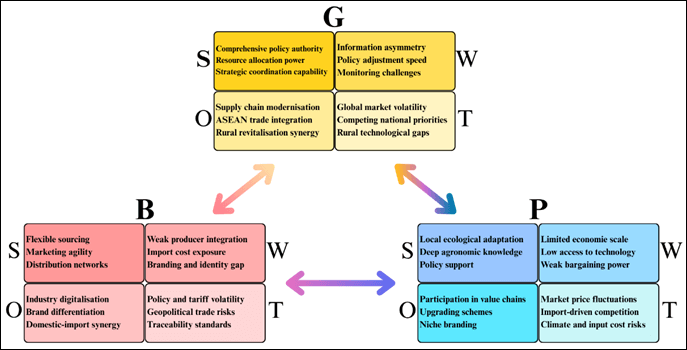
Figure 3. SWOT of All Stakeholders in China’s Milled Rice Industry.
Building upon this foundation, the expected payoffs for each stakeholder based on all possible strategy combinations and the corresponding probabilities are computed to determine how strategies evolve over time. This framework allows for the simulation of different governance pathways, helping to visualize how policy intensity, coordination, and institutional trust can shape long-term patterns of cooperation or resistance. It is especially relevant in contexts like China, where subsidy types, standards, and local policy implementation vary widely, affecting both strategic logic and behavioural inertia among stakeholders. Table 2 presents the complete payoff matrix for the tripartite evolutionary game in the milled rice industry.
Table 2. Payoff Matrix of Strategy Profiles
|
|
|
|
|
|
|
|
0 |
0 |
0 |
|
|
|
|
0 |
0 |
1 |
|
|
|
|
0 |
1 |
0 |
|
|
|
|
0 |
1 |
1 |
|
|
|
|
1 |
0 |
0 |
|
|
|
|
1 |
0 |
1 |
|
|
|
|
1 |
1 |
0 |
|
|
|
|
1 |
1 |
1 |
|
|
|

The mixed strategy probabilities
are denoted by  as
as enforces
 ,
,  as
as opts for
 , and
, and  as
as  chooses
 . The following section outlines the
expected payoffs and strategic dynamics for
. The following section outlines the
expected payoffs and strategic dynamics for ,
,  , and .
 (1)
(1)
 (2)
(2)
 (3)
(3)
The corresponding replicator dynamic equations are derived as:
 (4)
(4)
 (5)
(5)
 (6)
(6)
To analyze the local stability of the
evolutionary equilibria of,, and, the
Jacobian matrix is constructed. It is derived from the system of simplified
replicator dynamics. The Jacobian matrix captures the sensitivity of each
strategy’s growth rate. The eigenvalues indicate whether small perturbations
will decay or amplify over time. Specifically, an equilibrium is deemed locally
stable if all eigenvalues of the Jacobian matrix at that point have negative
real parts. This implies that the strategy profile resists deviations, and the
system tends to return to that state. Conversely, if any eigenvalue possesses a
positive real part, the equilibrium is unstable. Where eigenvalues have mixed
signs, there is a saddle point, which indicates directional instability—meaning some perturbations grow while others
decay. Thus, by explicitly evaluating the Jacobian elements at each
equilibrium, one can systematically identify which strategic configurations,, andare
capable of sustaining themselves dynamically under small shocks or fluctuations
in behavior.
 (7)
(7)
 (8)
(8)
 (9)
(9)
 (10)
(10)
 (11)
(11)
 (12)
(12)
 (13)
(13)
 (14)
(14)
 (15)
(15)
 (16)
(16)
The interactions among, , and
, and are not
fixed but dynamically evolve depending on the cost-benefit structures and
policy environments. It reflects the institutional,
market, and social entanglements in China’s agricultural governance landscape.
These interactions are not abstract, for they mirror the real-world
coordination challenges that arise in balancing food security, rural
livelihoods, and environmental governance in the rice sector. These
interactions define the strategic interdependence that drives the replicator
dynamics when each stakeholder’s payoff is not determined in isolation but
evolves in response to the strategies adopted by the other two.
are not
fixed but dynamically evolve depending on the cost-benefit structures and
policy environments. It reflects the institutional,
market, and social entanglements in China’s agricultural governance landscape.
These interactions are not abstract, for they mirror the real-world
coordination challenges that arise in balancing food security, rural
livelihoods, and environmental governance in the rice sector. These
interactions define the strategic interdependence that drives the replicator
dynamics when each stakeholder’s payoff is not determined in isolation but
evolves in response to the strategies adopted by the other two.
↔ : The
government sets regulatory frameworks, subsidies, and standards that directly
influence the operational costs and strategic compliance decisions of rice
enterprises. Enterprises, in turn, respond by either complying or evading,
which affects the government’s
symbolic regulatory payoff and enforcement cost. This interaction captures
top-down policy effectiveness and its feedback on institutional legitimacy.
This modelled interaction is crucial because it allows simulation of regulatory
slack or effective enforcement scenarios. This can also guide policymakers to fine-tune adaptive regulatory
designs that are both cost-effective and institutionally credible.
↔ : Milled
rice enterprises’ domestic
business depends on smallholder producers for raw inputs. Their decision
whether to engage fairly influences producers’ loyalty and productivity. Producers, depending on perceived
benefits, choose whether to collaborate—thereby shaping business payoffs and
long-term supply chain stability. The dyad captures market-based coordination
and trust-building mechanisms, reflecting real-world scenarios such as the
success or failure of contract farming initiatives. This component helps
predict supply chain stability, identify conditions for mutual trust formation,
and evaluate the long-term viability of inclusive business models.
↔ :
Producers rely on the government for access to infrastructure, extension
services, and protection against market risks. The government, in return, gains
or loses grassroots support depending on how well it addresses rural concerns.
Compliance or resistance from producers feeds back into the political and
economic costs of policy implementation, modeling the state-society
interaction. The model captures how producers respond to state interventions.
It is not with perfect rationality, but based on bounded learning from past
outcomes. In this way, the model reflects actual dynamics of policy uptake,
grassroots resistance, or informal circumvention, often observed in rural
development programs. This facilitates a better understanding of institutional
responsiveness and the political economy of rural support systems.
These triadic relationships are embedded in
the payoff matrix and encoded in parameters such as ,  ,
,  ,
,  ,
,  ,
,  , , , ,
  ,
,  ,
,  , , , , ,
  ,
,  , and
, and  . These
parameters determine the direction and stability of strategy evolution over
time. Their calibration ensures that the model captures the co-evolutionary
logic of real-world stakeholder dynamics in China’s milled rice industry. Thus, these interactions and parameters are
not just structural components, as they are the engines of the model, allowing
it to simulate adaptive governance, regulatory resilience, and market
inclusivity in a grounded and policy-relevant way.
. These
parameters determine the direction and stability of strategy evolution over
time. Their calibration ensures that the model captures the co-evolutionary
logic of real-world stakeholder dynamics in China’s milled rice industry. Thus, these interactions and parameters are
not just structural components, as they are the engines of the model, allowing
it to simulate adaptive governance, regulatory resilience, and market
inclusivity in a grounded and policy-relevant way.
This analytical approach enables a deeper interpretation of the eigenvalues themselves, where specific strategy profiles reveal the underlying structural stability of the system. In the eigenvalues of the Jacobian matrix, the strategy profiles (0,0,1) and (0,1,0) represent partial market-based activation without government intervention. These configurations are inherently unstable and can hardly withstand even minor perturbations.
(0,0,1) means smallholder producer collaboration alone. This producer collaboration may support resource pooling, standardized processing practices, and shared infrastructure use. Yet, the absence of business engagement restricts market integration, while limited regulatory support may constrain the scale and credibility of the collaboration. Consequently, gains in grassroots-level efficiency may not translate into broader system improvements. Similarly, (0,1,0) means business collaboration alone. Businesses acting in concert can strengthen bargaining positions, stabilize procurement, and enhance downstream coordination. Nonetheless, without producer alignment, upstream supply variability may undermine contract enforcement and logistical planning. Governmental absence may also lead to weak oversight, insufficient support for smallholders, and barriers to traceability or sustainability certification efforts.
Meanwhile,
(1,1,0) and (0,1,1) reveal an economic contradiction: the producer would
rationally abandon its original strategy, rendering these combinations
unsustainable in equilibrium. At (1,1,0), since  , if
, if  , would
switch to , violating . In the
equilibrium conditions of point (0,1,1) with
, would
switch to , violating . In the
equilibrium conditions of point (0,1,1) with  and
and  , for ,
 and
and  , and
the stable status must meet the following requirements at the same time as
, and
the stable status must meet the following requirements at the same time as  and
and  . Thus, faces
an awkward situation like the prisoner’s dilemma of high cost and almost no premium. If reverts
to as a solution, the equilibrium is destroyed.
. Thus, faces
an awkward situation like the prisoner’s dilemma of high cost and almost no premium. If reverts
to as a solution, the equilibrium is destroyed.
(1,1,0) enables regulatory enforcement and coordinated procurement strategies, potentially standardizing quality and promoting traceability. However, exclusion of producers from decision-making can lead to policy misalignment, implementation challenges, and erosion of producer autonomy. Top-down approaches may fail to reflect the realities and constraints of smallholder farming, ultimately compromising policy effectiveness and equity. (0,1,1) suggests the middle-ground configuration. There is some level of horizontal coordination within the value chain, potentially improving efficiency and communication between supply and demand. However, lacking state involvement may inhibit long-term infrastructure investment, consistent quality controls, and dispute resolution mechanisms. Over time, asymmetries between powerful businesses and vulnerable producers could widen, which would reduce inclusivity and stability.
Moreover,
(1,0,0) and (1,0,1) are mathematically stable when  ,
violating the logic of reality. Therefore, although these saddle points may
appear mathematically stable, they lack real-world viability due to stringent
constraints or inherent contradictions with economic logic, making long-term
stability unlikely in practice.
,
violating the logic of reality. Therefore, although these saddle points may
appear mathematically stable, they lack real-world viability due to stringent
constraints or inherent contradictions with economic logic, making long-term
stability unlikely in practice.
(0,0,0) and
(1,1,1) demonstrate both theoretical stability and practical feasibility. For
(0,0,0), local stability is achieved when  and
and  ,
revealing the lower cost of and . For
(1,1,1), stability could be reached with positive incentive effects in
,
revealing the lower cost of and . For
(1,1,1), stability could be reached with positive incentive effects in  ,
,  and
and  . The
equilibrium proves particularly robust as it satisfies all three conditions
simultaneously, representing a stable state where all parties are optimally
incentivized.
. The
equilibrium proves particularly robust as it satisfies all three conditions
simultaneously, representing a stable state where all parties are optimally
incentivized.
(0,0,0)
represents a scenario of independent strategies across,, and. This
configuration reflects a decentralised and market-led arrangement. Its
advantages lie in maintaining flexibility and allowing actors to tailor
decisions to local conditions. However, the lack of strategic coordination may
result in fragmented supply chains, inconsistent quality standards, and missed
opportunities for structural improvement. This autonomy can limit resilience
against collective shocks or long-term environmental and economic pressures.
The (0,0,0) equilibrium represents a stable but low-engagement state within the
milled rice collaboration system. While this configuration maintains systemic
balance, it offers minimal collective benefits and reflects widespread
stakeholder disengagement. Transitioning toward a more participatory and mutually
beneficial state, such as the (1,1,1) equilibrium, requires timely and
well-calibrated interventions. These early efforts can disrupt entrenched
patterns, shift stakeholder expectations, and establish the foundations for
voluntary coordination. Importantly, such a transition is not automatic; in the
absence of strategic action, the system may persist at (0,0,0), remaining
stable yet underperforming in terms of long-term developmental gains. In
contrast, (1,1,1) involves full collaboration among,, and. This
ideal-type scenario reflects an integrated governance model with joint
decision-making and resource sharing. It offers the potential for high levels
of system efficiency, equitable value distribution, and policy responsiveness.
Nonetheless, it requires significant institutional coordination, trust, and
administrative capacity.
Beyond the pure strategy points, there is a
possibility of a feasible mixed-strategy equilibrium  . Such
an interior equilibrium reflects a dynamic balance where none of the strategies
dominate, and all stakeholders maintain adaptive behaviors based on expected
payoffs. It is rigorously characterized by the following conditions, as
. Such
an interior equilibrium reflects a dynamic balance where none of the strategies
dominate, and all stakeholders maintain adaptive behaviors based on expected
payoffs. It is rigorously characterized by the following conditions, as  ,
,  , where
 , and
, and . As
such, there are also critical thresholds for stability,
which focus on the minimum incentive threshold as
follows:
. As
such, there are also critical thresholds for stability,
which focus on the minimum incentive threshold as
follows:
 (17)
(17)
If  , the
system inevitably converges to one of the pure-strategy equilibria. When approaches
but remains marginally below the minimum threshold, the system exhibits
metastable characteristics, with slow convergence and heightened sensitivity to
parameter fluctuations. The specific equilibrium attained is determined by the
relative magnitudes of the remaining parameters. It may go for (0,0,0) if
, the
system inevitably converges to one of the pure-strategy equilibria. When approaches
but remains marginally below the minimum threshold, the system exhibits
metastable characteristics, with slow convergence and heightened sensitivity to
parameter fluctuations. The specific equilibrium attained is determined by the
relative magnitudes of the remaining parameters. It may go for (0,0,0) if  or (0,0,1) if
  .
.
Compared to static optimization or linear equilibrium models often used in agri-policy analysis, the evolutionary game approach presented here offers greater flexibility in capturing dynamic behavioral shifts, bounded rationality, and stakeholder learning over time. Unlike general equilibrium models that assume full information and instant adjustment, this framework allows for path dependency, delayed responses, and institutional feedback, providing a more realistic depiction of rural governance under uncertainty.
However, while this enhances explanatory power, the model’s accuracy remains contingent on how well the parameters reflect real-world dynamics, particularly in assigning costs, incentives, and behavioral thresholds. Hassini et al. (2025) provided an insightful analysis of the transformative potential of IoT technologies within food supply chains, rigorously elucidating how digital integration enhances coordination, mitigates food waste, and influences pricing dynamics—thereby setting a valuable precedent for modeling technological impacts on supply chain resilience and sustainability. Li and Liu (2025) also presented a mathematically rigorous framework wherein the construction of Lyapunov functionals is adeptly employed to establish global stability and convergence toward coexistence equilibria, offering a high standard of analytical precision that is instructive for complex system modeling. Mutuku et al. (2025) offered valuable methodological inspiration by a nuanced computational modeling approach, particularly in its integration of spatial dynamics and real-world exposure scenarios to inform effective interventions. In sum, the mixed-strategy equilibrium captures a dynamic balance in which no single pure strategy dominates absolutely, where each stakeholder adopts their strategies with certain probabilities. This state reflects real-world complexity. It embodies adaptive behavior under uncertainty, bounded rationality, and evolving payoffs. Stakeholders continuously adjust, learn, and respond to each other, preventing lock-in to rigid patterns. The mixed equilibrium offers a robust but fluid stability, different from the fixed-point stability of a pure evolutionarily stable strategy. It acknowledges that perfect coordination is rare, yet cooperation can persist in a probabilistic or contingent form. Thus, future improvements of this study could involve incorporating agent-based extensions to simulate heterogeneous actors, calibrating the model using longitudinal data, and integrating spatial layers or ecological feedback to better reflect the complexity of cross-regional supply chain networks. Such enhancements would improve both predictive validity and policy relevance.
4. Discussion
To illustrate the three-dimensional evolutionary trajectories of strategy choices, this study incorporates a conceptual parameter simulation grounded in the complex and heterogeneous reality of rice subsidy schemes in China.
The country exhibits a high diversity in subsidy types, fluctuating subsidy amounts, and region-specific implementation practices. By incorporating real-world incentive structures and institutional mechanisms, the framework captures both the theoretical dynamics of strategic interaction and the practical realities shaping decision-making in China’s rice economy. The Hunan case exemplifies this approach, where comprehensive policy measures, including targeted subsidies, institutional innovations, and market stabilization tools, have produced measurable impacts on agricultural productivity and stakeholder behavior. These empirical observations directly inform the model’s parameterization, ensuring its outputs reflect the complex interplay of economic incentives and policy interventions characteristic of China’s agricultural modernization process.
Hunan’s policy trajectory offers a precise and data-rich foundation for this calibration (sourced from Department of Agriculture and Rural Affairs of Hunan Province [https://agri.hunan.gov.cn/]; Official website of the Hunan Provincial Government [www.hunan.gov.cn]; Hunan Daily [https://epaper.voc.com.cn/]; and China.com.cn & China.org.cn [http://agri.china.com.cn]). The province’s 2019 Hunan Agricultural Subsidy and Fee Policy and the 2020 CPC Hunan Provincial Committee No. 1 Document underscored a steadfast commitment to securing grain production, integrating acreage and yield stability into the provincial governor’s food security responsibility system. These policies pressed municipal and county governments to maintain local grain output, enforced strict arable land protection targets, and guarded the “red line” for farmland preservation by prioritizing early rice cultivation, scaling specialized seedling nurseries, expanding high-grade rice planting, promoting drought-tolerant coarse grains, and preventing farmland abandonment. Measures also included strict pest and disease control, reforms to grain reserve systems, implementation of minimum purchase price schemes, and targeted land allocation for leading grain-producing counties. In 2024, Hunan achieved a historic grain output of 61.56 billion jin (30.78 million tonnes), accounting for 4.4% of national production on just 2.8% of China’s arable land, a testament to its efficiency as one of only two provinces to continuously supply commercial grain since 1949. This success stems from targeted policies directly mirrored in the model as follows.
In subsidy mechanisms, the province
mobilized 95 billion yuan for farmland protection and seedling infrastructure,
with an additional 9 billion yuan for mechanized planting support, reflected in
the model’s incentive parameters (, ). Farmers
received 500 yuan/mu (0.0667 ha) in direct subsidies and insurance payouts,
aligning with the payoff structures (, ) for
adopting collaborative practices. However, there were per-mu payments of 109.1
yuan for single-season rice and 182.91 yuan for double-season rice, comprising
13.5 yuan/mu in direct grain
subsidies, 80.6 yuan/mu in
comprehensive agricultural input subsidies, 15 yuan/mu in quality seed
subsidies for early, middle, and late rice (for each type), and an additional
58.81 yuan/mu for double cropping.
In institutional innovations, Hunan’s 42.5
million mu of high-efficiency farmland (yielding 200 yuan/mu in cost savings
and productivity gains) informs the model’s cost-benefit trade-offs (, ) for
enterprises (). The more than
95% adoption rate of high-yield hybrid rice seeds for a legacy of Hunan’s
leadership in seed innovation validates the evolutionary dynamics of strategy
diffusion in the simulation. The previous complementary programs included
returning-farmland-to-forest living allowances of 20 yuan/mu, grain support
payments of 210 yuan/mu, and forest ecological compensation of 10.5 yuan/mu to
incentivize sustainable land use and production stability.
In market stabilization tools, the guidance
pricing for fertilizers via Hunan’s supply cooperatives and minimum grain
purchase guarantees by provincial reserves are captured in the model’s latent
regulatory gains () and
risk-reduction payoffs ( → ). For
example, by 2024, the agricultural department had been providing seeds free of charge, while agricultural machinery
operation teams had offered
free mechanized plowing and planting services under certain circumstances. Among other support measures, machinery purchase subsidies covered up
to 30% of costs in 2019.
By calibrating the model to these
real-world levers—subsidies, institutional trust, and market safeguards—the
adaptive coordination, such as the sequence of ’s policy shifts → ’s import strategies → ’s production
upgrades, emerges in transitional economies. This bridges theoretical rigor
with actionable policy insights, demonstrating how positive-sum outcomes arise
from aligned incentives.
Based on this context, the simulation explores the evolutionary pathways under specified payoff conditions. So, this study employs EG-Moderate and EG-Optimized as two conceptual configurations to simulate the evolutionary dynamics within China’s rice subsidy governance system.
This framework is constructed in three integrated stages.
In Stage 1 Conceptual Design, the framework
is built on institutional economics, rural policy frameworks, and strategic
interaction logics of government regulators (),
milled rice enterprises (), and domestic
smallholder producers ().
In Stage 2 Mathematical Formulation,
differential equations are developed for , , and using
replicator dynamics, with payoff matrices dependent on cost-benefit
calculations under each strategy configuration.
In Stage 3 Numerical Simulation, simulations are conducted to visualize system trajectories and equilibrium stability under different parameter conditions. The software MATLAB R2016b is used in Stage 3.
The numerical simulations are performed by MATLAB R2016b’s built-in ordinary differential equation (ODE) solver ode45 that implements an adaptive Runge-Kutta method. This solver was selected for the following principal reasons, including algorithmic robustness and field-standard validation, which ensure the reliability of the evolutionary game dynamics analysis.
In algorithmic robustness, the method employed by ode45 provides automatic step-size control, dynamically adjusting the temporal resolution during integration. This adaptive approach maintains optimizing computational efficiency, particularly crucial for the system where strategy proportions may exhibit both rapid transitions near bifurcation points and prolonged quasi-equilibrium periods. In field-standard validation, as the default ODE solver in MATLAB for non-stiff systems, ode45 has undergone extensive numerical validation through decades of application across ecological systems, evolutionary game theory, and engineering control systems. All numerical simulations were conducted with absolute tolerance of 1×10⁻⁸ and relative tolerance of 1×10⁻⁶. The parameters ensure solution accuracy while preventing artificial stabilization that could occur with overly lax tolerances.
The implementation explicitly avoids using MATLAB version-specific features since MATLAB R2016b was chosen as a long-term support release with proven numerical stability for solving ODEs.
In EG-Moderate, the parameter values are defined as follows: 
 . For
EG-Optimized, the configuration
is adjusted to reflect a scenario of stronger governmental and market
incentives aiming at milled rice collaborative optimization:
. For
EG-Optimized, the configuration
is adjusted to reflect a scenario of stronger governmental and market
incentives aiming at milled rice collaborative optimization:

 . It is important to note that they are grounded in conceptual
realism. These configurations serve to illustrate how different cost-benefit
structures might shape stakeholder strategies, which are rooted in observed
trends and regulatory frameworks that influence strategic evolution. The models
highlight how slight adjustments in subsidy incentives, regulatory costs, or
perceived payoffs may collectively reshape governance equilibrium in the milled
rice sector. The simulation horizon is set to t = 100, which enhances the
visibility of dynamic stability and allows for a clearer interpretation of
long-run strategy convergence across the triadic interactions of
. It is important to note that they are grounded in conceptual
realism. These configurations serve to illustrate how different cost-benefit
structures might shape stakeholder strategies, which are rooted in observed
trends and regulatory frameworks that influence strategic evolution. The models
highlight how slight adjustments in subsidy incentives, regulatory costs, or
perceived payoffs may collectively reshape governance equilibrium in the milled
rice sector. The simulation horizon is set to t = 100, which enhances the
visibility of dynamic stability and allows for a clearer interpretation of
long-run strategy convergence across the triadic interactions of  , and , as visualized
in Figure 4.
, and , as visualized
in Figure 4.
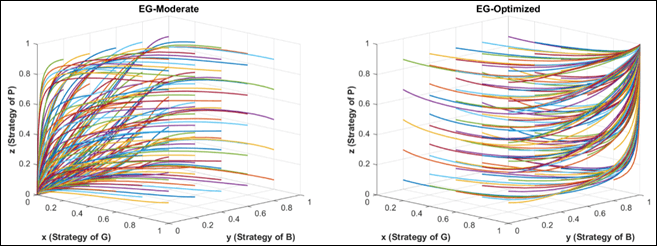
Figure 4. Simulated Evolutionary Trajectories of Tripartite Strategies in China’s Milled Rice Industry.
Figure 4 depicts the
evolutionary dynamics of stakeholder strategies under two distinct parameter
settings: EG-Moderate and EG-Optimized. EG-Moderate
denotes a scenario characterized by moderate governmental and market incentives
coupled with a balanced cost-benefit environment, where stakeholder strategies
tend to stabilize near the status quo. In contrast, EG-Optimized captures a
setting with intensified policy incentives and differentiated payoffs that
drive dynamic convergence toward proactive coordination among  and .
and .
In EG-Moderate, the evolutionary path tends to
stabilize near (0,0,0), indicating that under moderate incentive structures and
relatively balanced cost-benefit profiles, and are
more inclined to retain the status quo, preferring minimal policy intervention,
conservative behaviour from enterprises, and passive public engagement. In
contrast, EG-Optimized, which
incorporates stronger governmental incentives and a more pronounced benefit
differential, displays a dynamic convergence toward (1,1,1).
Figure 4 offers a
comparative visualization of the strategic trajectories among , and across
two distinct governance scenarios, including EG-Moderate and EG-Optimized over
a simulation horizon of t = 100. The figure captures how variations in
parameterized incentives and costs influence the long-run evolutionary
stability of each stakeholder’s strategy.
The eight strategy vectors, ranging from (0,0,0) to (1,1,1), represent all possible combinations of strategic choices by the three stakeholders within the evolutionary game framework. Here, 0 indicates a passive, conservative, or non-cooperative strategy, while 1 signifies an active, reform-oriented, or cooperative stance.
For instance, (0,0,0) reflects a full-status quo scenario where no actor engages in proactive change, often leading to stagnation or policy inertia. In contrast, (1,1,1) captures a fully engaged and synergistic configuration.
Intermediate vectors illustrate partial alignments or mismatched behaviors, offering insights into transitional or unstable phases in the governance landscape as follows.
(0,0,1) reflects
only the domestic smallholder producers () adopt
an active strategy; government regulators () and
milled rice enterprises () remain passive.
(0,1,0) reflects only the milled rice enterprises () adopt
an active strategy; government regulators () and
domestic smallholder producers () remain passive.
(1,0,0) reflects that only the government regulators () adopt
an active strategy; milled rice enterprises () and
producers remain passive.
(0,1,1) reflects
milled rice enterprises () and domestic
smallholder producers () adopt active
strategies; government regulators () remain passive.
(1,0,1) reflects government regulators () and
domestic smallholder producers () adopt active
strategies; milled rice enterprises () remain passive.
(1,1,0) reflects government regulators () and
milled rice enterprises () adopt active
strategies; domestic smallholder producers () remain
passive.
Each intermediate vector reflects real-world governance asymmetries where only subsets of actors respond to policy shifts or market changes.
In the EG-Moderate configuration, the dynamics reveal a gradual convergence toward the strategy vector (0,0,0). This outcome signifies a systemic reluctance to engage in proactive behaviors: the government refrains from implementing stringent regulatory or incentive-based policies; enterprises do not perceive sufficient marginal benefits from collaborative behaviors; and smallholder producers maintain low engagement due to minimal institutional and economic support. The convergence toward this inactive equilibrium highlights how moderate incentive structures and low differential returns fail to disrupt the status quo, reinforcing conservative governance logic and fragmented stakeholder coordination.
Conversely, the EG-Optimized configuration exhibits a sharply contrasting dynamic. Here, the figure shows a clear upward trajectory toward the strategy vector (1,1,1), reflecting high levels of strategic engagement from all three actors. The strengthened incentives, particularly the increase in regulatory rewards, enterprise benefits, and public incentives, alter the payoff landscape enough to shift the population dynamics toward cooperation and alignment. Over time, this leads to the emergence of a self-reinforcing virtuous cycle in which active governance, enterprise compliance, and public responsiveness mutually validate and stabilize one another. This equilibrium is not only evolutionarily stable but also socially desirable, as it embodies the systemic conditions under which rice subsidy policies can become both efficient and inclusive.
Thus, Figure 4 serves as a dynamic diagnostic tool, enabling stakeholders and policymakers to visualize the non-linear feedbacks and thresholds embedded in governance structures. It illustrates how even marginal adjustments in policy levers can lead to qualitatively different governance equilibria. Importantly, the model demonstrates that fostering a high-engagement equilibrium (as in EG-Optimized) is not merely a function of increasing all incentives indiscriminately but of strategically realigning incentives to generate cross-actor complementarities, as a finding with direct implications for real-world policy design and institutional reform in China’s rice subsidy system.
The emergence of EG-Moderate and EG-Optimized as stable yet fragile equilibria reflects not a deficiency in institutional design, but an inherent feature of rural governance systems marked by uneven infrastructural access and varying incentive responsiveness. These outcomes suggest that regulatory coherence alone is insufficient; rather, strategic stability hinges on calibrated reciprocity across government, enterprises, and producers. When policies offer moderate but credible incentives, and when infrastructure enables timely participation, even partial alignment can stabilize cooperation. This interpretation is consistent with studies emphasizing that in complex value chains, adaptive coordination and relational trust often matter more than rigid compliance frameworks (Li, 2025; Waqas et al., 2025; Yu et al., 2025).
This suggests
that under intensified incentive mechanisms and more compelling returns for
proactive strategies, , , and are more
likely to coordinate around active government regulation, enterprise
compliance, and public responsiveness.
By embedding these complex interdependencies into a formal evolutionary game framework, the model becomes a decision-support tool for adaptive governance. It offers several key benefits to society as follows.
In evidence-based policy design, the model allows policymakers to simulate how changes in subsidies or transaction costs ripple through the system, offering insights into which policy levers lead to cooperative equilibrium across the three actors.
In early warning for systemic risk, the model helps identify unstable equilibria or strategy collapses, such as a scenario where producers collectively withdraw or enterprises disengage due to high compliance costs. Recognizing these inflection points can inform preemptive interventions, ensuring food security and rural economic stability.
In inclusive rural development, by highlighting conditions that promote trust-based cooperation, the model contributes to more equitable participation of smallholder farmers in value chains. It supports initiatives that build resilience, not dependency, among vulnerable rural actors.
In stakeholder dialogue and negotiation, the model provides a transparent platform for dialogue among stakeholders. By making strategic feedback loops explicit, it can be used in policy sandbox environments to test alternative rules, incentivize experimentation, and build consensus.
In sum, the
interactions among,, and in the
model are not only analytically significant but also deeply reflective of China’s
institutional realities and policy challenges. The model offers a structured
way to navigate these complexities, yielding actionable insights that can
enhance governance capacity, promote inclusive growth, and foster ecological
sustainability in the milled rice industry and beyond.
The proposed evolutionary game model benefits society by serving as a strategic decision-support tool that bridges theoretical modeling with real-world agricultural governance challenges. First, it enables evidence-based policy formulation by simulating how changes in subsidies or transaction costs influence the strategic behavior of government regulators, enterprises, and smallholder producers. This empowers policymakers to design more targeted, efficient, and equitable interventions that reduce regulatory failure, rent-seeking, and producer marginalization.
Second, the model facilitates inclusive rural development by identifying conditions under which cooperative strategies become evolutionarily stable, thus supporting long-term trust and fair value distribution across the supply chain. This is particularly beneficial in empowering smallholders to move from subsistence participation to meaningful integration within the rice economy.
Finally, the model enhances institutional learning and stakeholder dialogue. By making feedback loops and behavioral thresholds explicit, it enables scenario testing in policy sandbox settings and encourages cross-sector coordination. As a result, it strengthens governance capacity, minimizes unintended policy consequences, and improves the resilience and adaptability of the agricultural system—benefiting both rural communities and society at large.
The divergence among these models highlights how slight shifts in regulatory pressure and incentive allocation can fundamentally alter the strategic trajectory of all players involved. It underscores the sensitivity of system outcomes to policy design, not only in quantitative terms but in shaping collective behavior over time.
These findings reframe stability not as a static endpoint but as a launchpad for strategic transformation. What the game model identifies in formal terms can be reinterpreted as practical tensions and leverage points for systemic change. This transition from diagnostic insight to transformative strategy is where technical modeling meets developmental vision. Rather than treating system attributes as fixed descriptors, the SOAR (Strengths, Opportunities, Aspirations, Results) framework reimagines them as dynamic levers within a complex adaptive system. Within this framework, strengths and opportunities are not simply assets to catalogue. They act as institutional ignition points that shape the landscape on which aspirations such as inclusivity, resilience, and global competitiveness can gain operational momentum. The game model warns that in the absence of coordinated action, the system may remain locked in suboptimal equilibria. These may be stable in a mathematical sense, but socially stagnant or economically inefficient. Saddle points in particular reveal the fragility of isolated efforts. They expose scenarios where promising initiatives fail to scale, or where innovation occurs without structural reinforcement.
Applied strategically, SOAR transforms these analytical insights into a forward-looking governance architecture. It shifts the emphasis from planning as prediction to planning as active calibration. Results are no longer seen as final outputs but as emergent patterns, sustained through iterative adaptation and multi-actor alignment. In this light, SOAR is not merely a reflective tool but a directional compass that helps navigate long-term transitions. It connects equilibrium analysis with meaningful change, ensuring that China’s milled rice industry does not just stabilize around favorable configurations but evolves through intelligent coordination, institutional synergy, and alignment with both national goals and global sustainability imperatives, visualized in Figure 5.
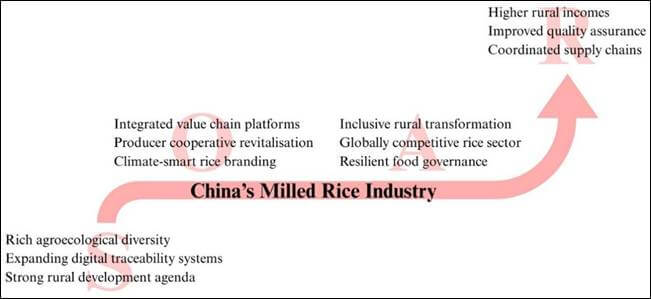
Figure 5. Simulated Evolutionary Trajectories of Tripartite Strategies in China’s Milled Rice Industry.
Anchored in this strategic foundation, the ensuing analysis advances a deeper inquiry into the research questions, translating theoretical insights into empirically grounded explanations.
The SWOT analysis of all stakeholders in China’s milled rice industry serves as a critical empirical and conceptual foundation for the construction of the three-party evolutionary game model. Each component of the SWOT—including strengths, weaknesses, opportunities, and threats—captures the strategic environment and bounded rationality of the actors, aligning closely with the model’s assumptions about adaptive behavior and payoff sensitivity.
In particular, the strengths and weaknesses of each stakeholder group define their initial strategic advantages and constraints, shaping the relative payoff structures in the model. For instance, the government’s institutional leverage is a strength, while enforcement asymmetry may be a weakness while both of which directly affect its cost-benefit matrix when choosing between regulatory strategies. Similarly, milled rice enterprises’ market access or technological efficiency can be modeled as strengths, whereas dependence on subsidies may constitute a vulnerability. These empirical realities inform the parameterization of the replicator dynamics, allowing the model to simulate realistic adaptation processes.
Meanwhile, opportunities and threats reflect dynamic external factors, such as evolving policies, standards, or pressures, which, although held constant in the short run within the model, still shape stakeholder expectations and potential shifts in payoff landscapes. This ensures that while the model remains structurally closed for analytical clarity, it still resonates with broader real-world policy contexts and sectoral developments.
Therefore, the SWOT analysis does not merely support the model, for it anchors it in context-sensitive realism, enabling it to capture how the strategic interactions among stakeholders unfold within China’s actual rice governance ecosystem. It strengthens the model’s credibility, policy relevance, and applicability by ensuring that simulated dynamics are not abstract or arbitrary, but reflective of the real-world capacities, incentives, and vulnerabilities of the actors involved. In response to RQ1, the results illuminate how government-led incentives, market-driven procurement strategies, and behavioural adjustments by domestic producers form a co-evolutionary triad. These interactions unfold through nonlinear feedback mechanisms within a complex adaptive system. Government regulators act as institutional architects, shaping the strategic landscape through policy instruments and regulatory signals. Market businesses, particularly those engaged in milled rice procurement, respond to or resist these signals, amplifying or muting the intended policy effects through selective sourcing behaviours. Domestic producers, positioned at the supply chain base, dynamically adjust their practices in response to these shifting signals. This interdependency reinforces systemic responsiveness and strategic coupling across actors, thereby contributing to SDG 2 (Zero Hunger) via food security enhancement and sustainable agriculture, and to SDG 12 (Responsible Consumption and Production) through improved quality control and resource efficiency.
Concerning RQ2, the results confirm that tripartite collaboration is anchored in joint engagement among stakeholders. It is not only desirable but essential to the structural stability of China’s rural milled rice supply chain. Stability analysis via Jacobian eigenvalues reveals that fragmented or binary coalitions tend to exhibit saddle-point characteristics as mathematically stable in one direction but vulnerable to perturbations in another. In contrast, full coordination, particularly strategy profile (1,1,1), emerges as the most resilient configuration under dynamic perturbations. This strategic synergy directly supports SDG 8 (Decent Work and Economic Growth) by reinforcing inclusive rural employment and entrepreneurship, while also advancing SDG 9 (Industry, Innovation and Infrastructure) through value chain digitization, infrastructure enhancement, and traceability technologies.
5. Conclusions
This study unpacks the milled rice industry not merely as an agricultural subsector but as a strategic theatre where institutional incentives, infrastructural asymmetries, and behavioral responses converge into evolving patterns of cooperation and divergence. It finds that structural stability within China’s milled rice supply chain is not a given but an emergent outcome of synchronized expectations and strategic alignment among government regulators, enterprises, and smallholder producers. Through the evolutionary game framework, it identifies that effective rural governance does not require perfect consensus; rather, it depends on credible expectations and robust feedback loops. The model shows that stability is not a static endpoint but a dynamic process. It is the process shaped by the mutual calibration of institutional rules, infrastructural capacity, and stakeholder behaviour. Milled rice, in this context, becomes more than a staple crop—it transforms into a strategic signal that reflects the underlying strength of trust, responsiveness, and infrastructural integration across the rural economy.
The structural instability and coordination failures that often characterize China’s milled rice industry, where fragmented incentives and uneven infrastructure hinder coherent cooperation between government regulators, enterprises, and smallholder producers. The model was designed to investigate whether institutional incentives and behavioural dynamics can be strategically aligned to stabilize rural value chains. Through an evolutionary game framework, the study successfully demonstrates that such alignment is possible by shaping credible expectations and fostering synchronized feedback mechanisms among stakeholders.
Through an evolutionary game lens, it reveals that structural stability within China’s rural supply chains is not an automatic outcome, but an emergent property shaped by the alignment or misalignment of three interdependent forces: rules that guide engagement, roads that enable participation, and rice as the value-laden commodity that binds them. The model identifies not just endpoints of equilibrium, but the conditions under which these equilibria become socially meaningful and resilient. The discovery suggests that rural governance does not require perfect consensus to function effectively; what matters more is the credibility of expectations and the strength of feedback loops. In sum, the findings reimagine stability as a process of iterative synchronization. This process transforms milled rice from a staple crop into a strategic mirror reflecting the depth of institutional trust, policy responsiveness, and infrastructural integration.
While rooted in the structural contours of China’s milled rice industry, the model’s architecture holds interpretive resonance far beyond its immediate context. The tripartite interaction among state, market, and producers echoes across rural value chains where trust, timing, and institutional asymmetries shape collective outcomes. It is governed not by command but by calibrated reciprocity. The identified equilibria capture the kind of strategic ambiguity familiar to other agri-food systems navigating reform, decentralization, and globalization. Though embedded in China’s unique policy terrain, the relational patterns illuminated here are translatable that they invite comparative applications in similarly transitional contexts, where infrastructure, incentives, and identities remain in flux.
In practice, the analysis reorients the policymaking lens from control to coordination, from compliance to coherence. The discovery of fragile yet recurrent saddle points reveals that fragility is not a deviation from policy but often its unintended product. Fragility arises when one stakeholder moves ahead without the responsive participation of others. Stability, therefore, emerges not from the mere existence of formal rules but from the rhythm of mutual anticipation and alignment. In such a system, governance becomes less about issuing directives and more about composing conditions, where rules and relational trust converge to nurture adaptive capacity. Policies that embed such logic are not only more resilient but more humane, recognizing the lived uncertainty of those who plant, trade, and consume.
While the current model offers a compelling analytical lens, it operates under a set of necessary abstractions. The binary strategy vectors, though analytically tractable, simplify the more complex and nuanced spectrum of real-world stakeholder behaviour. In addition, the exclusion of ecological disruptions, climate-related risks, and international trade spillovers, though intentional to preserve model clarity, limits the explanatory scope of the model in increasingly globalized agri-food systems. Future research could enrich the model through dynamic parameterization, empirical calibration using real-time datasets, and the integration of digital agricultural platforms and climate adaptation mechanisms. Such extensions would deepen its policy relevance, especially in an era where food security is increasingly shaped by climate volatility and cross-border interdependence. Recognizing these limits invites future interdisciplinary engagement and empirical grounding. As with any model, abstraction brings both clarity and constraint. The binary strategy set simplifies a spectrum of behaviors, and feedback loops shaped by ecological disruptions or cross-border trade spillovers remain outside the present scope. Future iterations would benefit from dynamic parameterization, real-time data calibration, and the inclusion of digital supply chain innovations and climate risk scenarios. Yet these simplifications offer a conceptual skeleton upon which future layers of empirical richness may be added. The exclusion of ecological disruptions, climate-related risks, and international trade spillovers, though intentional to preserve model clarity, limits the explanatory scope of the model in increasingly globalized agri-food systems. Future research could enrich the model through dynamic parameterization, empirical calibration using real-time datasets, and the integration of digital agricultural platforms and climate adaptation mechanisms. Such extensions would deepen its policy relevance, especially in an era where food security is increasingly shaped by climate volatility and cross-border interdependence. Recognizing these limits invites future interdisciplinary engagement and empirical grounding.
This study composes a narrative of evolving interdependence, where milled rice becomes a signal. It reframes stability as a pattern of synchronized expectations, forged not through mandates but through mutual foresight. The framework developed here bridges game theory with developmental realism, grounding equilibrium concepts in the granular realities of rural governance. It opens new analytical pathways for integrating institutional design, behavioral strategy, and infrastructural planning into a unified logic of transformation. In doing so, it contributes to the growing corpus of scholarship that sees agriculture as a frontier of strategic innovation.
CRediT Author Statement: Changjun He: Conceptualization, Methodology, Data curation, Writing – original draft, Visualization, Investigation, Software, Validation, and Writing – review & editing; Rajah Rasiah: Supervision; Chng Saun Fong: Supervision.
Data Availability Statement: The raw data supporting the findings of this study are available from the corresponding author upon reasonable request.
Funding: This research received no external funding.
Conflicts of Interest: The authors declare no conflict of interest.
IRB Statement: Not applicable.
Informed Consent Statement: Not applicable.
Acknowledgments: The authors would like to thank the anonymous reviewers and editors for their valuable suggestions and comments, which helped improve this manuscript.
Abbreviations
The following abbreviations are used in this manuscript:
|
IL |
Ionic Liquid |
|
ASEAN |
Association of Southeast Asian Nations |
|
USD |
United States Dollar |
|
RMB |
Renminbi Yuan |
|
CSI |
China Securities Index Co.,Ltd |
|
DCE |
Dalian Commodity Exchange |
|
ZCE |
Zhengzhou Commodity Exchange |
|
SDG |
Sustainable Development Goal |
|
FAO |
Food and Agriculture Organization |
|
SWOT |
Strengths, Weaknesses, Opportunities and Threats |
|
SOAR |
Strengths, Opportunities, Aspirations, Result |
|
RQ |
Research Question |
|
CPC |
Communist Party of China |
|
EG |
Evolutionary Game |
|
ODE |
Ordinary Differential Equation |
References
Baylis, K., Heckelei, T., & Hertel, T. W. (2021). Agricultural trade and environmental sustainability. Annual Review of Resource Economics, 13, 379–401. https://doi.org/10.1146/annurev-resource-101420-090453
Bischi, G. I., Baiardi, L. C., Lamantia, F., & Radi, D. (2024). Nonlinear dynamics and game-theoretic modeling in economics and
finance.
Annals of Operations Research, 337, 731–737. https://doi.org/10.1007/s10479-024-06016-2
Calingacion, M., Laborte, A., Nelson, A., Resurreccion, A., Concepcion, J. C., Daygon, V. D., Mumm, R., Reinke, R., Dipti, S., Bassinello, P. Z., Manful, J., Sophany, S., Lara, K. C., Bao, J., Xie, L., Loaiza, K., El-hissewy, A., Gayin, J., Sharma, N., … Fitzgerald, M. (2014). Diversity of global rice markets and the science required for consumer-targeted rice breeding. PLOS ONE, 9(1), e85106. https://doi.org/10.1371/journal.pone.0085106
Campitelli, G., & Gobet, F. (2010). Herbert Simon’s decision-making approach: Investigation of cognitive processes
in experts. Review of
General Psychology, 14(4),
354–364. https://doi.org/10.1037/a0021256
Dorosh, P. A. (2001). Trade liberalization and national food security: Rice trade between Bangladesh and India. World Development, 29(4), 673–689. https://doi.org/10.1016/S0305-750X(00)00121-2
Enthoven, L., & Van den Broeck, G. (2021). Local food systems: Reviewing two decades of research. Agricultural Systems, 193, 103226. https://doi.org/10.1016/j.agsy.2021.103226
Erhardt, T., & Weder, R. (2020). Shark hunting: On the vulnerability of resources with heterogeneous species. Resource and Energy Economics, 61, 101181. https://doi.org/10.1016/j.reseneeco.2020.101181
Eshoa, E., & Zomorrodi, A. R. (2024). Precision game engineering through reshaping strategic payoffs. Scientific Reports, 14, 25226. https://doi.org/10.1038/s41598-024-72543-4
Fischer, I., Avrashi, S., & Givon, L. (2024). Subjective game
structures: Eliciting
alternatives and payoffs to study the properties of social
interactions. Experimental Economics, 27(4),
922–944. https://doi.org/10.1007/s10683-024-09828-y
Geng, Y., Yang, X., Zhang, N., Li, J., & Yan, Y. (2024). Sustainable rural development: Differentiated paths to achieve rural revitalization with case of Western China. Scientific Reports, 14, 31507. https://doi.org/10.1038/s41598-024-83339-x
Gomoyunov, M. I., & Lukoyanov, N. Y. (2024). The value and optimal strategies in a positional differential
game for a neutral-type system. Proceedings
of the Steklov Institute of Mathematics, 327(Suppl1), S112–S123.
https://doi.org/10.1134/S0081543824070083
Halpern, B. S., Frazier, M., Verstaen, J., Rayner, P.-E., Clawson, G.,
Blanchard, J. L., Cottrell, R. S., Froehlich, H. E., Gephart, J. A., Jacobsen,
N. S., Kuempel, C. D., McIntyre, P. B., Metian, M., Moran, D., Nash, K. L.,
Többen, J., & Williams, D. R. (2022). The environmental footprint of global
food production. Nature Sustainability, 5, 1027–1039.
https://doi.org/10.1038/s41893-022-00965-x
Hassini, E., Ben-Daya, M., & Bahroun, Z. (2025). Modeling
the impact of IoT technology on food supply chain operations. Annals of
Operations Research, 348,
1619–1648. https://doi.org/10.1007/s10479-023-05464-6
Irshad, M. K., Ibrahim, M., Noman, A., Shang, J., Mahmood, A., Mubashir,
M., Khoo, K. S., Ng, H. S., & Show, P. L. (2022). Elucidating the impact of
goethite-modified biochar on arsenic mobility, bioaccumulation in paddy rice (Oryza
sativa L.) along with soil enzyme
activities. Process Safety and Environmental
Protection, 160, 958–967.
https://doi.org/10.1016/j.psep.2022.02.069
Jiang, C., & Luo, Y. (2025). Evolutionary game of dynamic adjustment mechanisms in tripartite cooperation for ESG performance. Scientific Reports, 15, 9104. https://doi.org/10.1038/s41598-025-90385-6
Li, J. (2025). Tracing the restructuring and industrialisation of upland agriculture in Southwest China, 2008 – 2019. Food Security, 17, 603–623. https://doi.org/10.1007/s12571-025-01534-8
Li, S., & Liu, C. (2025). Global boundedness and stability to a three-species food chain model with density-dependent motion. Communications on Pure and Applied Analysis, 24(6), 1019–1047. https://doi.org/10.3934/cpaa.2025022
Mirowski, P. (1994). [Review of the book Economics, bounded rationality and the cognitive revolution, by H. Simon, M. Egidi, R. Marris, & R. Viale]. Southern Economic Journal, 60(3), 786–787. https://doi.org/10.2307/1060599
Mobarok, M. H., Thompson, W., & Skevas, T. (2021). COVID-19 and policy impacts on the Bangladesh rice market and food security.
Sustainability, 13(11), 5981. https://doi.org/10.3390/su13115981
Mohidem, N. A., Hashim, N., Shamsudin, R., & Che Man, H. (2022). Rice for food security: Revisiting its production, diversity, rice milling process and nutrient content. Agriculture, 12(6), 741. https://doi.org/10.3390/agriculture12060741
Musthofa, M. W., & Engwerda, J. (2025). Robust soft-constrained Nash equilibria in the multi-player discrete-time descriptor dynamic game. Journal of Optimization Theory and Applications, 206, 26. https://doi.org/10.1007/s10957-025-02695-4
Mutuku, J. K., Kung, H.-C., Chen, W.-H., Huang, C.-E., Khoo, K. S., & Show, P. L. (2025). Influence of bifurcation morphology on exercise-induced PAH deposition in the lungs: A computational modeling approach for air quality research. Biomechanics and Modeling in Mechanobiology, 24, 1295–1312. https://doi.org/10.1007/s10237-025-01968-1
Pretty, J., Benton, T. G., Bharucha, Z. P., Dicks, L. V., Flora, C. B.,
Godfray, H. C. J., Goulson, D., Hartley, S., Lampkin, N., Morris, C.,
Pierzynski, G., Prasad, P. V. V., Reganold, J., Rockström, J., Smith, P.,
Thorne, P., & Wratten, S. (2018). Global assessment of
agricultural system redesign for sustainable
intensification. Nature Sustainability, 1, 441–446.
https://doi.org/10.1038/s41893-018-0114-0
Pu, L., & Xiang, M. (2025). Effects of future climate and cropland use changes on rice potential yields in
Hainan Island, China. Chinese
Geographical Science, 35,
438–453. https://doi.org/10.1007/s11769-024-1475-0
Roux, N., Kastner, T., Erb, K.-H., & Haberl, H. (2021). Does agricultural trade reduce pressure on land ecosystems? Decomposing drivers of the embodied human appropriation of net primary production. Ecological Economics, 181, 106915. https://doi.org/10.1016/j.ecolecon.2020.106915
Saravia-Matus, S., Gomez y Paloma, S., & Mary, S. (2012). Economics of food security: Selected issues. Bio-based and Applied Economics, 1(1), 65–80. https://doi.org/10.13128/BAE-10552
Sarfo, I., Qiao, J., Lingyue, L., Qiankun, Z., Darko, G., Yeboah, E.,
Alriah, M. A. A., Gagakuma, D., & Amara, D. B. (2024). Why is rural
revitalization difficult to achieve? An in-context
discussion of conceptual barriers to China’s 2018–2022 strategic plan. Environment,
Development and Sustainability. https://doi.org/10.1007/s10668-024-05353-3
Sent, E.-M. (2018). Rationality and bounded rationality: You can’t have one without the other. The
European Journal of the History of
Economic Thought, 25(6),
1370–1386. https://doi.org/10.1080/09672567.2018.1523206
Sriariyanun, M., Kitiborwornkul, N., Tantayotai, P., Rattanaporn, K., &
Show, P.-L. (2022). One-pot ionic liquid-mediated bioprocess for
pretreatment and enzymatic hydrolysis
of rice straw with ionic liquid-tolerance bacterial cellulase. Bioengineering,
9(1), 17.
https://doi.org/10.3390/bioengineering9010017
United Nations. (2015). Transforming our world: The 2030 agenda for sustainable
development.
https://sdgs.un.org/sites/default/files/publications/21252030%20Agenda%20for%20Sustainable%20Development%20web.pdf
Ushakov, V. N., & Ershov, A. A. (2024). On the construction of solutions to a game problem with a fixed end time. Proceedings of the Steklov Institute of Mathematics, 327(Suppl 1), S239–S256. https://doi.org/10.1134/S0081543824070186
Waqas, M., Farooq, F., Bhat, M. A., Sibt-e-Ali, M., & Batool, K.
(2025). Crafting a sustainable environment
through green energy, financial development
and agriculture in the BRICS economies. Journal of the Knowledge
Economy.
https://doi.org/10.1007/s13132-025-02694-w
Wieland, A., & Durach, C. F. (2021). Two perspectives on supply chain resilience. Journal of Business Logistics, 42(3), 315–322. https://doi.org/10.1111/jbl.12271
Xie, H., Li, J., Li, T., Lu, X., Hu, Q., & Qin, Z. (2025). GloRice, a global rice database (v1.0): I. Gridded paddy rice annual distribution from 1961 to 2021. Scientific Data, 12, 182. https://doi.org/10.1038/s41597-025-04483-1
Yu, N., Xiong, K., Zhao, R., & Feng, F. (2025). Quantification and
attribution of agriculture eco-efficiency in the desertification control of
South China Karst core area. Environment, Development and Sustainability.
https://doi.org/10.1007/s10668-025-06286-1
Zhang, J., Li, P., Li, S., & Lyu, Z. (2025). Assessment of environmental impacts of heavy metal pollution in rice in Nanning, China. Scientific Reports, 15, 3027. https://doi.org/10.1038/s41598-024-84989-7
Zhang, S., Liu, X., Shen, L. D., Song, H., Wang, W.-q., & Kong, M.
(2025). Distribution and influencing factors of antibiotic resistance genes in
rice paddy soils in China. Journal of Soils and Sediments, 25,
1657–1667.
https://doi.org/10.1007/s11368-025-04033-7
Zhang, Y., & Li, Y. (2025). A new framework for rural development
assessment from a systemic perspective: A case from karst mountainous areas in
southwest China. Journal of Mountain Science, 22, 1169–1188.
https://doi.org/10.1007/s11629-024-8993-1
Disclaimer: The views, statements, and data presented in Agricultural & Rural Studies (A&R) reflect solely the perspectives of the individual authors and contributors, and do not represent the official positions of SCC Press and/or the editorial team. SCC Press and/or the editorial team assume no liability for any harm, injury, or damage to persons or property arising from the ideas, methodologies, instructions, or products referenced herein.